
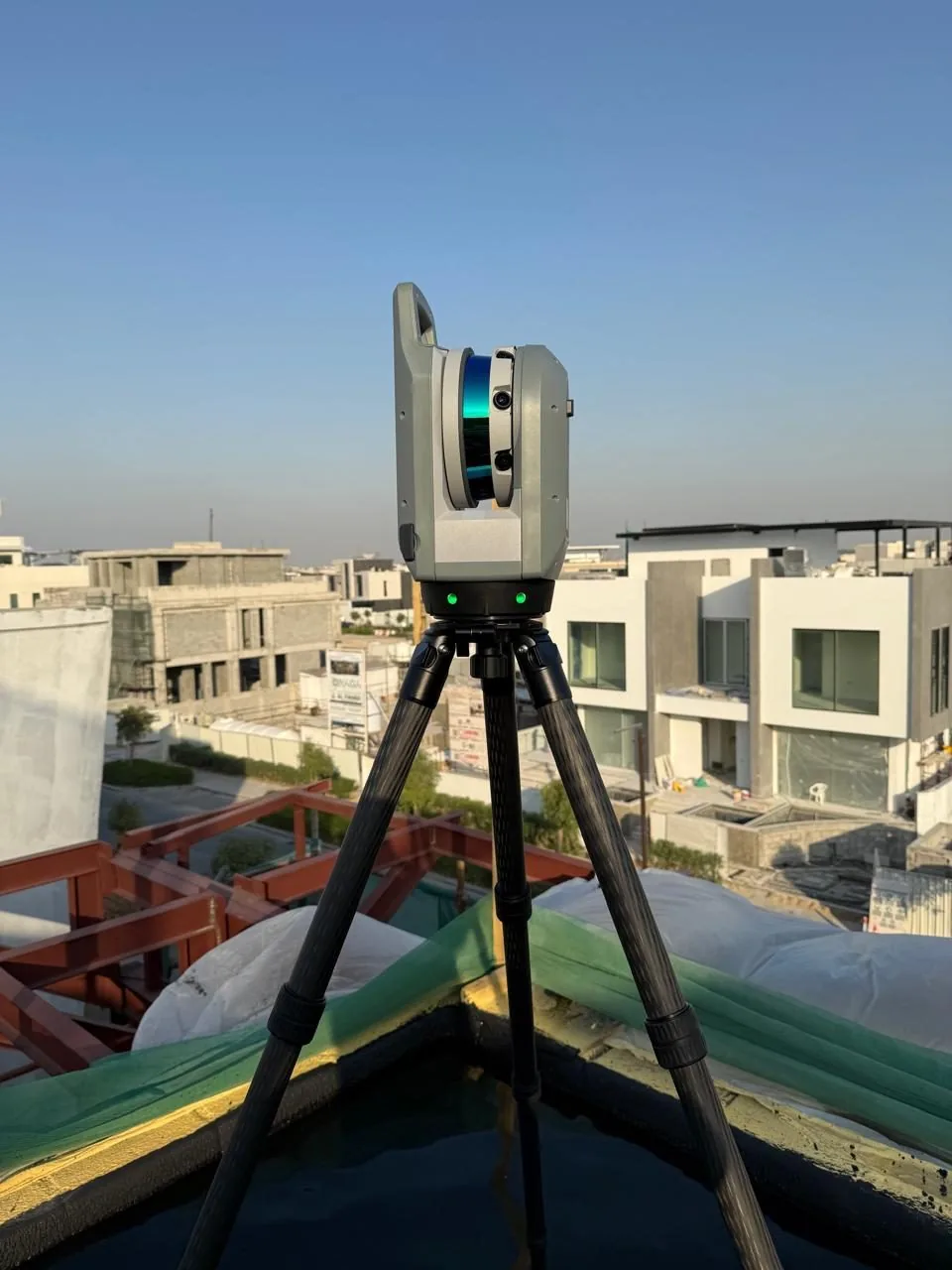
01 · Real Dervoss deliverable
Registered point cloud
Cleaned, registered scan data as .RCP / .E57, full-colour, ±2 mm, captured with the Trimble X9.
3D Scanning & BIM — 01
3D laser scanning captures an existing building or site as millions of precise measured points (a "point cloud"), creating an exact digital record you can model, measure and build from.
Dervoss scans rooms, whole buildings, façades, industrial plants, sites and large objects such as boat hulls across Dubai, the UAE and Saudi Arabia, and produces the drawings and models in-house.
Illustration
From site scan to 3D model
How scan to model works: individual scan positions are registered into one point cloud, and the walls, floors and openings are then modelled directly on top of the measured points.
02 — What you receive
3 deliverables
01 · Real Dervoss deliverable
Cleaned, registered scan data as .RCP / .E57, full-colour, ±2 mm, captured with the Trimble X9.
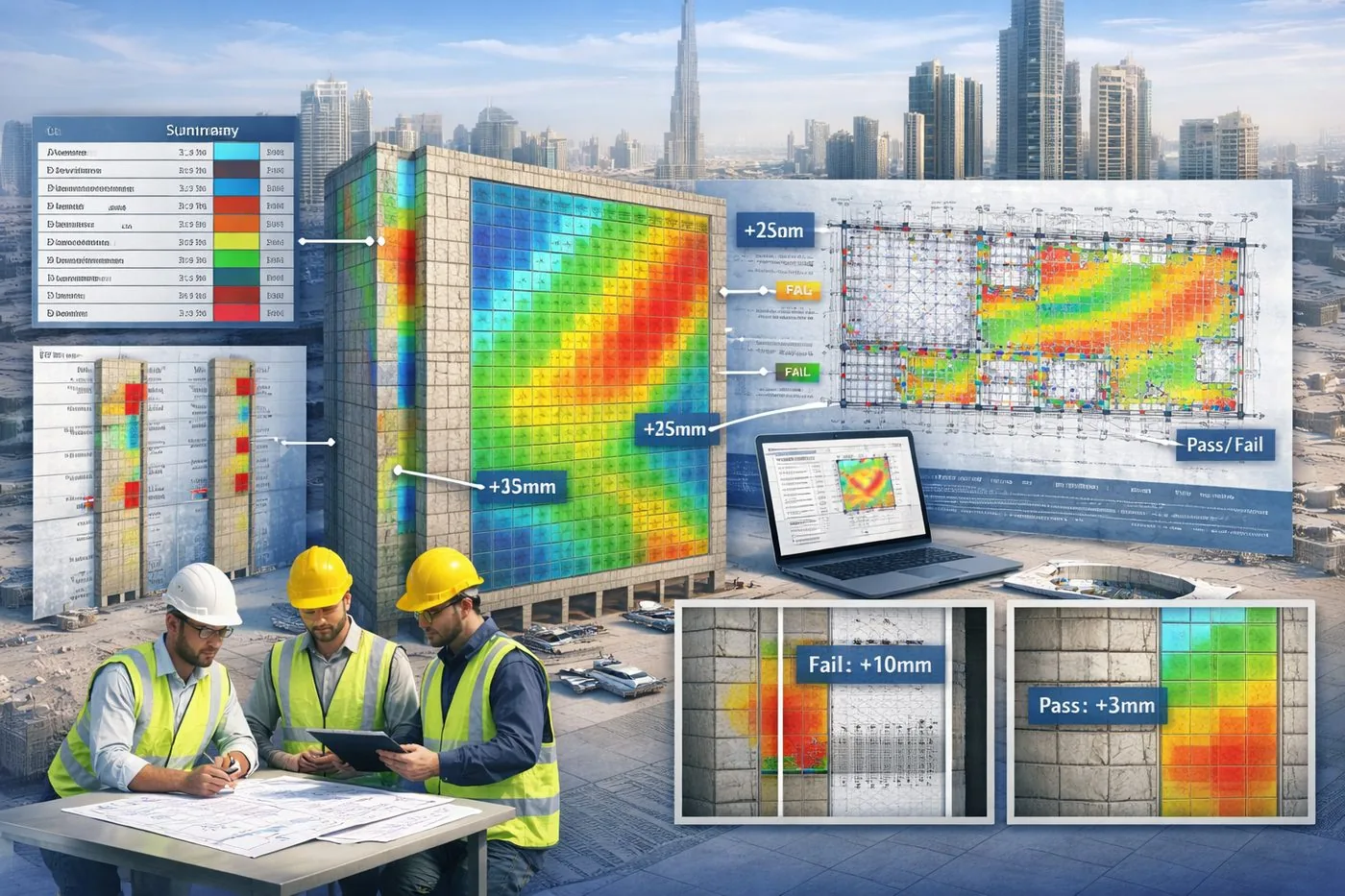
02 · Illustration
Every delivery ships with an accuracy statement. Flatness, verticality and deviation reports against your tolerance are available from the same scan.
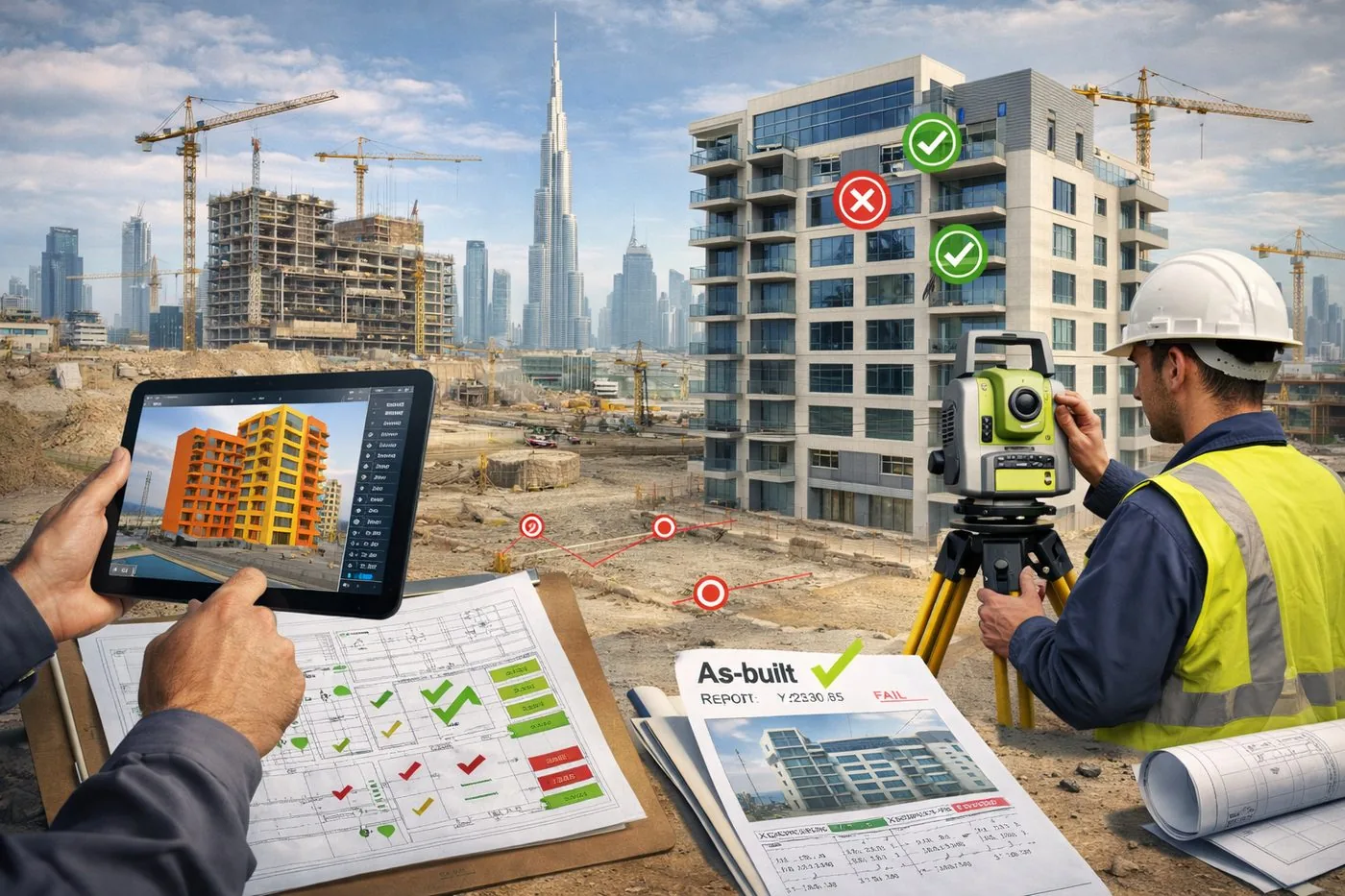
03 · Illustration
2D drawings or a Revit model produced in-house from the same scan, the deliverable most clients actually need.
Formats
.RCP.E57DWG (optional)Revit (optional)03 — When you need it
01
The verified starting point for any design or renovation.
02
One scan serves drawings, models and records.
03
Compare as-built reality against design (verticality, deformation, flatness).
04
Scan live facilities with minimal disruption to operations.
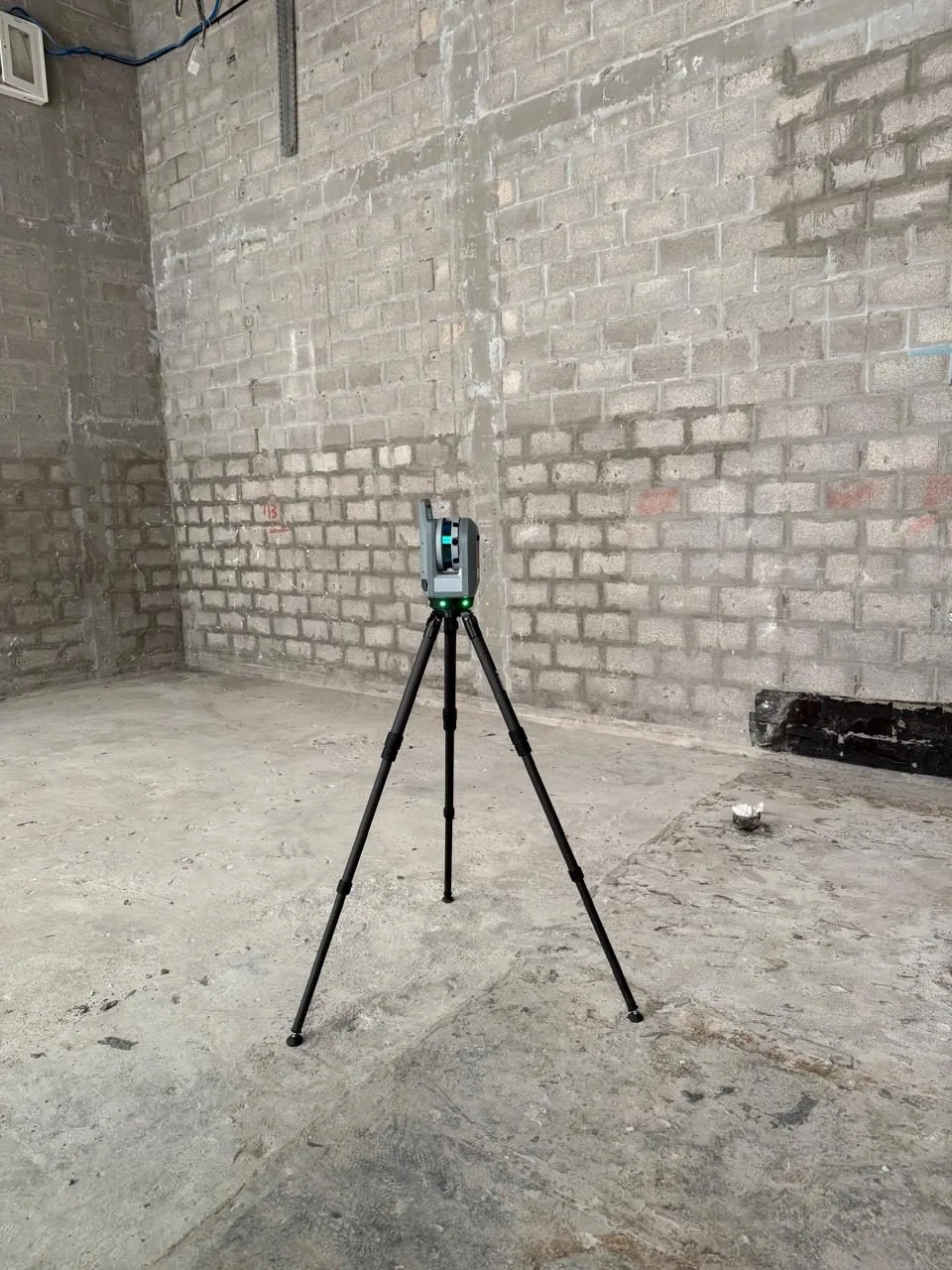
Site photo · Dervoss
04 — Real project · Dubai
A design team took on a café fit-out in a narrow existing unit, with no drawings at all. No floor plan, no sections, nothing to design on.
The designers received a clean point cloud and accurate as-built base drawings of the unit, and could start design work immediately: no site remeasurement, no assumptions, no surprises at fit-out.
Point cloud + as-built drawings / 3D model
Read the case study05 — How it works
Step 01
We survey or scan your site with survey-grade instruments: every surface and dimension captured in a single visit, with minimal disruption.
Step 02
The field data is processed, registered and checked into one accurate dataset, the verified foundation everything else is built on.
Step 03
Our in-house team produces your deliverables (drawings, maps, reports or Revit models), reflecting exactly what is on site.
Step 04
You receive your files in the agreed formats, with an accuracy statement. We stay available for revisions and questions after handover.
06 — In detail
The site photos on this page are our own teams on UAE sites (rooftops, stairwell shafts, villa communities) with the Trimble X9 that captures every project. One scanner position records millions of measured points in minutes; a full building is typically captured in a single visit, occupied or not, with no manual measuring and no disruption worth mentioning.
What makes scanning valuable isn’t the cloud itself; it’s what the data can do. For designers, it’s the verified base for renovation and fit-out (as-built drawings, measured surveys). For engineers, it’s construction verification: verticality checks on cores and façades, deformation monitoring, and flatness and deviation reports measured against the design and your tolerance. For BIM teams, it’s the input to a Revit model built in-house by the same people who captured the site. For owners, it’s a permanent, re-measurable record of the asset.
| Manual measurement | 3D laser scanning | |
|---|---|---|
| Data captured | Selected dimensions only | Every surface: millions of points |
| Accuracy | Errors accumulate reading by reading | ±2 mm, uniform across the space |
| Site time (typical unit) | Days, with return visits for missed dimensions | Hours, one visit; nothing is “missed” |
| Occupied buildings | Disruptive | Non-contact, work continues |
| Re-measuring later | Another site visit | Query the point cloud from your desk |
| Deliverables | The drawing you asked for | Drawings, model, verification, all from one dataset |
The last row is the quiet economics of scanning: the survey is captured once and every later question (a new fit-out, a dispute about a level, an MEP clash) is answered from the data, not from another mobilisation.
We plan scan positions from your floor plans (or a walkthrough where none exist), establish control so the scans tie to your project datum, then capture position by position. The Trimble X9 records each in minutes, colour included. A typical villa or retail unit is done in one visit; a tower floor-by-floor programme is sequenced around your access. Registration and QA happen the same week, and the accuracy report ships with the data, so what you receive is verified, not assumed.
Plants, hotels, malls and occupied towers can’t stop for a survey, and don’t need to. Laser scanning is non-contact and fast: we plan scan positions around your operations, capture congested plant rooms and ceiling voids exactly as they are, and leave with everything. Facilities teams use the result for retrofit planning, clash-free MEP routing and digital twins, without a single shutdown hour on the programme.
Dervoss’s 3D scanning services cover three situations. Building scanning captures shells, fit-outs, villas and towers for drawings and BIM. Site scanning captures external works, facades and structures alongside the topographic survey. Industrial 3D scanning documents plants, plant rooms and process areas while they operate, with scan positions planned around live equipment. All three use the same Trimble X9 capture and the same ±2 mm accuracy statement. The same method also captures film and VFX locations as scale-true digital environments.
For buildings and sites, very little. “LiDAR scanning” names the technology (a laser that measures distance), “3D laser scanning” names the survey, and “reality capture” is the industry’s umbrella term for turning a real place into measured digital data. All three describe what Dervoss does with the Trimble X9: capturing rooms, floors, façades, plants and sites as point clouds, then turning them into drawings, models and reports.
What it isn’t: scanning small objects or parts for 3D printing or product design. That’s a different kind of scanner and a different kind of company. If your project is a building, a site, a plant or a location, you’re in the right place.
Real Dervoss scans, from apartments to oil and gas platforms:
07 — Why Dervoss for 3D laser scanning
Most scanning companies hand your point cloud to an offshore modelling shop. Our UAE team captures the site AND produces the drawings and models: one contract, one accountable team, a model guaranteed to match the scan.
01
No hand-off between a scanning company and an offshore drawing shop: the team that measured your site produces your deliverables.
02
Trimble X9 laser scanning and survey-grade instruments, accurate to ±2 mm, with an accuracy statement per delivery.
03
All seven emirates, Saudi Arabia and the wider GCC, with deliverables prepared for local authority requirements.
04
On site within 24 hours of a confirmed LPO; urgent concrete and utility scans often same-day.
08 — Questions
3D laser scanning captures a building or site as millions of precise measured points (a point cloud), creating an exact digital record you can model, measure and build from. It's the core of what the industry calls reality capture.
Capturing existing conditions for design and renovation, producing as-built drawings and BIM models, verifying construction against design (verticality, deformation, tolerances), and documenting plants and facilities that change faster than their drawings.
Survey-grade scanners like our Trimble X9 capture to ±2 mm. Every Dervoss delivery includes an accuracy report, so the figure isn't a claim; it's documented per project.
It depends on the size and complexity of the space and what you need from the data: scan only, drawings, or a full model. Send the details and you get a fixed quote.
For a rough room concept: yes, phone LiDAR works. But it can't hold survey-grade accuracy across a whole building, and the output isn't accepted for design coordination or submission. Professional scanning captures millions of points at ±2 mm, and delivers a usable DWG or Revit file, not just a mesh.
A point cloud is the raw output of a laser scan: millions of measured points forming a precise 3D picture of your site. You can measure in it directly, or have it turned into drawings or a BIM model. See our point cloud to BIM guide.
Whichever you need. Point cloud alone if your team models in-house, or 2D drawings and a Revit model produced by the same team that scanned your site. That's the in-house chain.
09 — Get a fixed quote
Describe the job in your own words; you don't need to know the right survey name. A fixed price and a committed delivery date, no obligation. Plans or photos? Send them on WhatsApp.
On site
Within 24 h of a confirmed LPO
Office
Al Barsha South 3, Dubai
Hours
Mon-Fri 10:00-18:00